Reference
The Yarn Glossary
A working reference for yarn anatomy, weights, fibers, gauge, and how to make sense of mystery skeins. I keep this page open the same way I keep my notebook open: it has the answers I look up the most.
If you find a term you don’t see here, send me a message and I will add it.
Yarn anatomy
Hank. A loose loop of yarn, usually twisted into a figure eight and tied in a few places. A hank shows the colorway off beautifully, which is why most premium hand dyed yarn ships this way. You cannot knit straight from a hank. You have to wind it first.
Skein. A pre-wound oblong tube of yarn that you can pull from either end. Most commercial yarn ships in skeins because they stack on a shelf and don’t tangle on the way home.
Cake. A flat-sided cylinder of yarn wound on a ball winder. You pull from the center. Cakes do not roll across the floor while you knit, which is the main argument for them.
Cone. A rigid cone of cardboard or plastic with a lot of yarn wrapped around it. Used for weaving, machine knitting, and big garments that need yardage without a lot of joins.
Ball. A round, hand wound shape. Less common for premium yarn.
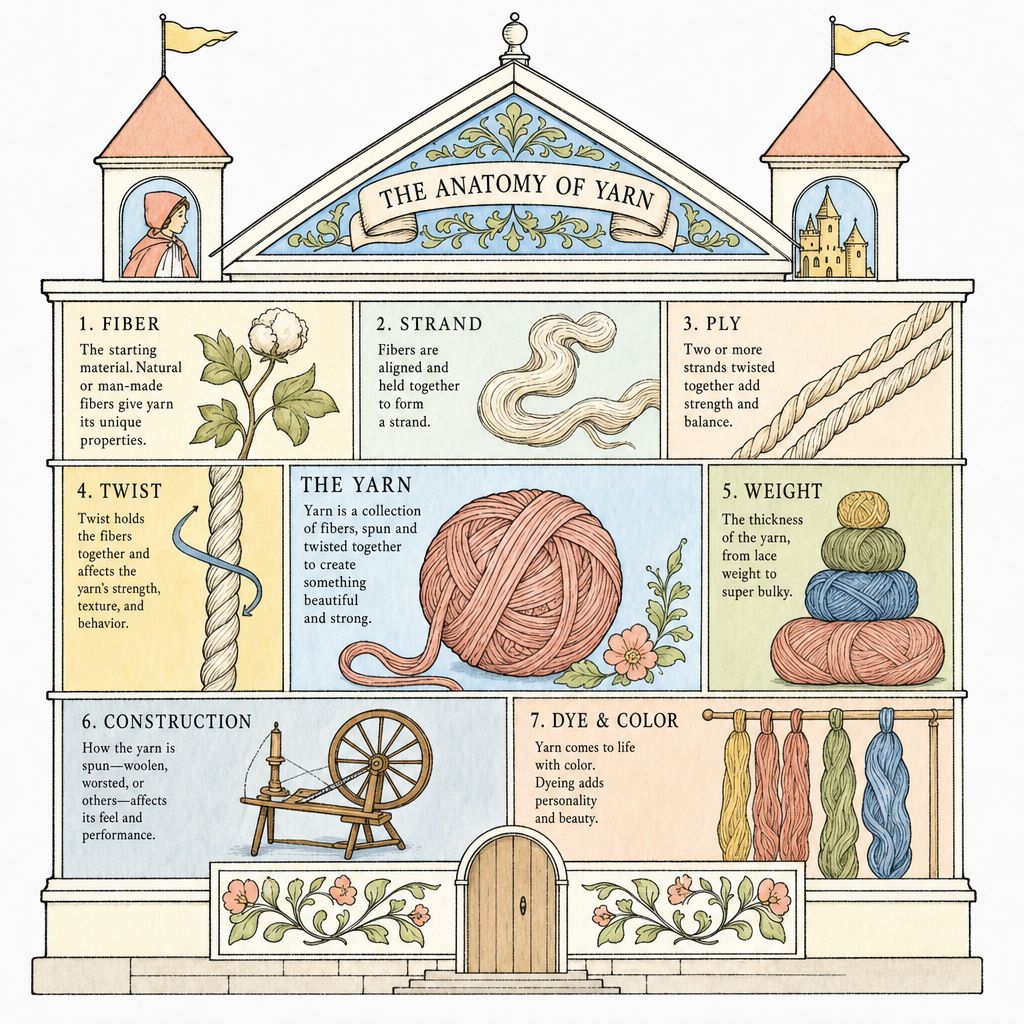
Ply. The number of strands twisted together to form the finished yarn. A 4 ply has four strands. A single ply is exactly one. More plies generally means smoother finish and better stitch definition. Singles drape softer but pill more.
How to unwind a hank without tangles
If you try to knit directly from a hank, you will end up with a ball of knots and a bad afternoon. Always wind a hank first.
The reliable way:
- Find a flat surface and good light.
- Untwist the figure-eight twist and let the hank fall open into a single loop.
- Slip the loop over the back of a dining chair, the arms of a yarn swift, a niddy noddy, or a friend’s hands held wide apart. The goal is to keep tension on the loop so it does not collapse.
- Find the small piece of waste yarn tying the loop together. Untie it carefully. There is usually a second tie. Untie that one too.
- Find one of the loose ends. Either end works.
- Wind into a cake using a ball winder, or wind into a center pull ball by hand around your fingers and thumb.
A swift and a ball winder turn this into a 60 second job. If you do not own them, the back of a dining chair works for most hanks. Move slowly, do not rush, and never pull against a tangle. If the hank gets snarled when you open it, lay it flat, find the loose end, and slowly trace the strand back through the snags by hand. Patience is the only tool that helps here.
Yarn weights and what they mean
Yarn weight is not the weight of the skein. It is the thickness of the strand itself. Weight category determines what size needle to use, what projects the yarn is suited for, and how the finished fabric will feel.
| Weight category | Common name | WPI | Typical gauge (sts/4 in) | Typical US needle |
|---|---|---|---|---|
| 0 | Lace / cobweb | 18+ | 32–40 | US 0–2 |
| 1 | Fingering / sock | 14–17 | 27–32 | US 1–3 |
| 2 | Sport / baby | 12–14 | 23–26 | US 3–5 |
| 3 | DK / light worsted | 11–12 | 21–24 | US 4–6 |
| 4 | Worsted / aran | 9–10 | 16–20 | US 6–9 |
| 5 | Bulky / chunky | 7–8 | 12–15 | US 9–11 |
| 6 | Super bulky | 5–6 | 7–11 | US 11–17 |
| 7 | Jumbo | 4 or fewer | 6 or fewer | US 17+ |
Yarn weight is not exact. Two yarns labeled DK can knit up at different gauges. The needle column is a starting point. Always swatch.
Wraps per inch (WPI) and how to measure it
WPI is the fastest way to figure out the weight of an unlabeled yarn. You wrap the strand around a ruler and count.
How to measure:
- Hold a ruler or a WPI tool steady.
- Anchor one end of the yarn and wrap it snugly around the ruler. The wraps should sit next to each other with no gaps and no overlap. Snug, not stretched.
- When you have wrapped well past one inch, count how many wraps fit in exactly one inch.
- Compare to the table above to find your weight category.
A few notes. Single-ply singles look thicker than they really are because they are loose. Wrap them carefully and do not squish. If your number sits between two categories, the yarn is probably a borderline case and either pattern would work. If you get wildly different numbers on different sections of the same skein, the yarn is uneven by design (most hand dyed singles do this) and you should average.
Gauge: what it is, why it matters, how to swatch
Gauge is the number of stitches per inch you get with a specific yarn, needle size, and tension. Two knitters with the same yarn and the same needles can produce different gauge. That is normal. Tension is personal.
Why gauge matters: a sweater pattern is calculated around a target gauge. If yours is off by even half a stitch per inch, the finished sweater can be one or two full sizes wrong.
How to swatch properly:
- Cast on at least 20 to 25 stitches in your project’s main stitch, usually stockinette. Knit for at least 4 inches.
- Bind off loosely.
- Wash and block the swatch the same way you will wash the finished item. This is the part most people skip and it is the part that matters most. Almost every yarn changes after the first wash, sometimes dramatically. Superwash relaxes. Linen softens. Wool blooms. Knit a swatch, wash it, then measure.
- Lay the swatch flat without pulling. Measure the number of stitches across 4 inches in the middle (not the edges, which curl).
- Divide by 4 to get stitches per inch.
If your gauge is too tight (more stitches per inch than the pattern calls for), go up a needle size. If it is too loose, go down. Re-swatch. Yes, every time.
Fibers and what they do
Wool. The default knitting fiber. Warm, springy, takes dye beautifully, holds its shape. Different breeds give different results: merino is soft, BFL has more luster, Shetland is heartier and slightly scratchy.
Merino. A type of wool from Merino sheep. Finer and softer than generic wool, but slightly less durable. Most luxury hand dyed yarn is merino.
Superwash wool. Wool that has been treated to remove the scales on the fiber so it can be machine washed without felting. Slightly less elastic than untreated wool and a touch slicker, but easy care.
Silk. Smooth, lustrous, drapey, very strong. Doesn’t have the bounce of wool, so silk-heavy yarns drape rather than spring. Often blended with wool for the best of both.
Cashmere. Soft, warm, lightweight, expensive. Pills more than wool. Usually shows up as a 5 to 25 percent blend with merino.
Alpaca. Warmer than wool by weight, with a slight halo. Less elastic than wool, so 100 percent alpaca garments grow with wear.
Mohair. From Angora goats. Famous halo, lightweight, often used as a lace-weight strand held with another yarn for a halo effect.
Cotton. No memory, cool to wear, takes color well. Stretches out and stays stretched, so not great for ribbing or fitted pieces. Beautiful for summer garments and accessories.
Linen. Cool, drapey, gets softer every wash. A bit unruly to knit because it has no give. Linen knits look better after a few washes, not before.
Bamboo. Drapey, smooth, slightly cool to the touch. Often blended with cotton or wool.
Nylon. Almost always 5 to 25 percent of a sock yarn blend, where it adds durability. On its own it is rare in knitting yarn.
Acrylic. Synthetic, machine washable, holds dye well, often inexpensive. Does not breathe like natural fibers but is great for items that get heavy use, like children’s wear or charity knitting.

How to identify a mystery yarn
If a yarn comes to you without a label, you can still figure out most of what you need.
Hand feel
- Soft and springy, slightly warm: probably wool or wool blend
- Soft, slick, very springy: probably superwash merino
- Cool, smooth, drapey, no spring: probably cotton, linen, bamboo, or silk
- Has a fuzzy halo: probably has alpaca, mohair, angora, or cashmere
- Squishy and lightweight with a faint halo: probably cashmere or cashmere blend
- Slick and a little squeaky: probably acrylic or has heavy synthetic content
Visual
- Multiple smooth plies twisted together: most natural fibers
- Single ply with no twist: usually wool or wool blend, often roving-style
- Sparkles or holographic glints: has nylon, polyester, or polyamide content
- Very fine, lustrous, silky drape: silk or silk blend
The burn test
This is the most reliable way to identify mystery fiber. Cut a 6 inch strand. Hold it with metal tweezers or pliers over a sink with water running. Light it on fire and observe.
- Smells like burnt hair, burns slowly, leaves a crumbly black ash: animal protein (wool, silk, alpaca, cashmere, mohair)
- Smells like burning paper, burns quickly with a steady flame, leaves soft gray ash: plant fiber (cotton, linen, bamboo, hemp)
- Melts into a hard plastic bead, smells chemical, drips: synthetic (nylon, polyester, acrylic)
- A mix of melting and ashing, with a chemical and a hair smell: a blend
Burn one strand at a time. Always over a sink with water on. Never burn yarn you cannot afford to lose, and never near valuable yarn nearby.
Estimating yardage from skein weight
If you know the weight in grams and the fiber, you can estimate yardage closely enough to plan a project.
| Weight category | Wool / merino (yds per gram) | Cotton (yds per gram) | Silk (yds per gram) |
|---|---|---|---|
| Lace | 5 to 6 | 4.5 to 5.5 | 5 to 6 |
| Fingering | 4 to 4.5 | 3.5 to 4 | 4 to 4.5 |
| Sport | 3.5 to 4 | 3 to 3.5 | 3.5 |
| DK | 2.5 to 3 | 2 to 2.5 | 2.5 |
| Worsted | 2 to 2.5 | 1.5 to 2 | 2 |
| Bulky | 1 to 1.5 | 1 | 1 |
| Super bulky | 0.5 to 1 | 0.5 | 0.5 |
So a 100 gram hank of fingering weight merino is roughly 400 to 450 yards. A 100 gram skein of worsted weight wool is roughly 200 to 250 yards. Cotton runs slightly heavier per yard because it is denser, so subtract about 10 percent off the wool numbers. Silk runs about the same as merino.
If you have a kitchen scale and a known yardage piece of yarn, you can do this exactly. Weigh a 5 yard length and divide. That gives you yards per gram for that specific yarn.
Care guide by fiber type
Always check the band first. If the band is missing, follow the rule for the most delicate fiber in the blend.
Superwash wool. Machine wash cold on a gentle cycle, lay flat to dry. Some superwash is dryer safe but tumbling can fuzz it over time. Will not felt.
Non-superwash wool. Hand wash cold with wool wash, no agitation, lay flat to dry. Will absolutely felt if agitated in hot water. (This is sometimes the goal, like for a felted bag, but rarely for a sweater.)
Cotton. Machine wash and dry. Cotton shrinks 5 to 10 percent the first wash, then stops. If gauge matters, pre-wash the yarn before knitting.
Linen. Machine wash, hang or lay flat to dry. Linen softens dramatically after the first three or four washes. Knit linen looks best after it has been worn a few times.
Silk. Hand wash cold with a gentle soap, lay flat to dry. Do not wring. Avoid direct sunlight while drying because silk fades.
Cashmere. Hand wash with wool wash or cashmere shampoo, lay flat to dry. Pills are normal. Use a cashmere comb to remove pills, do not pull them.
Alpaca. Hand wash cold, lay flat. Alpaca grows with wear, so block your finished item slightly smaller than you want.
Mohair. Hand wash, lay flat. The halo lifts beautifully after a wash. Do not block aggressively or you flatten the halo.
Acrylic. Machine wash and dry. Avoid high heat in the dryer because it can melt synthetic fibers.
Nylon and synthetic blends. Treat as the most delicate fiber in the blend. A 75 percent merino, 25 percent nylon sock yarn is treated like merino.
Other terms you will see in listings
Kettle dyed. The yarn is dyed in a single pot. Produces tonal variation across the skein, like deeper and lighter shades of the same color.
Hand painted. The yarn is laid out and color is applied to specific sections. Produces variegation and color repeats.
Speckled. Fine flecks of contrast color sprinkled across a base. Often combined with kettle or hand painted bases.
Tonal. A single hue with subtle shifts in depth across the skein. Calmer than variegated.
Variegated. Multiple distinct colors across the skein. Pools and stripes when knit.
Semi-solid. Almost solid, with very subtle tonal shift. Reads as a flat color from a distance.
Mill end. Yarn left over after a mill finishes a production run. Often unlabeled. Usually a great deal.
New old stock. Yarn that has been sitting in a shop or warehouse for years, never sold, still in original condition. Often discontinued lines.
Destash. Yarn from a personal stash or a closed shop, being resold. The rest of this site is destash.
Dye lot. A code on the band identifying which batch the yarn was dyed in. Skeins from different dye lots will not match exactly. Hand dyers usually skip dye lots because each skein is its own thing.
Frogged. Yarn that has been knit into something and then unraveled to be reused. Usually noted in the listing.
Felted. Wool yarn that has been intentionally agitated in hot water to lock the fibers together. Used for bags and slippers.
WPI. Wraps per inch. See above.
Gauge. Stitches per inch. See above.
Have a yarn term you want defined?
If you came here looking for a word and didn’t find it, send me a message and I will add it. The whole point of this page is to be useful.
Until then, happy knitting.
— Bridget